

To speed up screening for your systematic reviews, Covidence provides highlighting to help draw your eye to keywords in a study's title and abstract. You can set highlights for inclusion and exclusion keywords, to quickly determine whether a study is worth reviewing further.
Highlighting can work slightly differently depending on whether you add a single word or a phrase. This article explains how highlighting works, including why some words may not highlight related terms as you expect.
If you'd like to read more about how to use highlights in your review, check out How to create and manage keyword and phrase highlights.
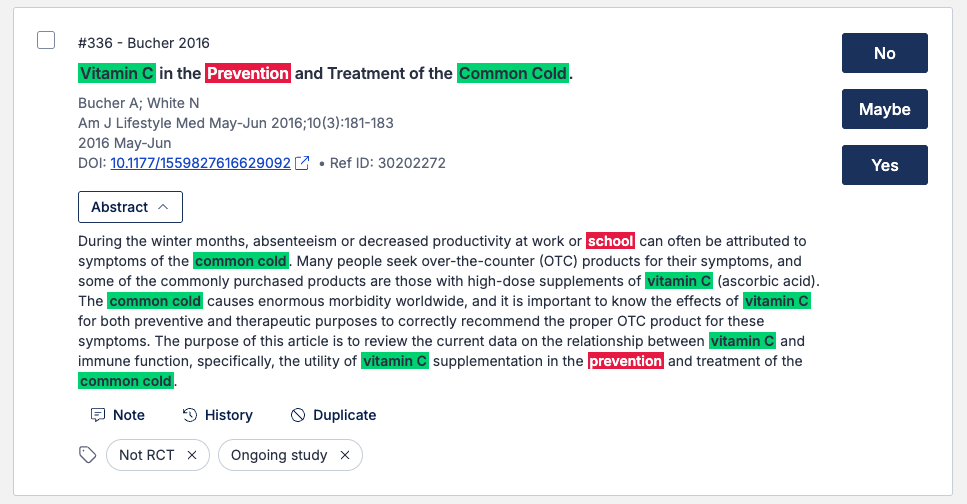
Covidence uses two approaches to highlighting, depending on whether you add a phrase or a single word.
Highlighting phrases
Phrases are matched as entered, regardless of capitalization. Whitespace differences are also handled.
For example, if you add “Mental Health” as a highlight, Covidence will highlight:
Mental Health
Mental health
mental health
Phrases aren’t stemmed, so adding a phrase doesn’t automatically highlight variations of the individual words.
Highlighting single words
Single words use exact matching and, where possible, stemming.
Stemming identifies the common root of a word and can highlight other words that share that root. This means you don’t need to add every variation of a word as a separate highlight.
For example, if you add “psychological”, Covidence can use its stem “psycholog” to highlight related words such as:
psychological
psychology
psychologies
The stem is used internally to find related words. Covidence keeps the original term you entered as your highlight.
Limits and exceptions
Word length
There is no minimum length for a highlight itself. Short words can still be saved and exact-matched.
However, words need to be at least three characters long for stemming to be applied. For shorter words, Covidence uses exact matching where applicable.
For example, “ex” can be used as a highlight and matched exactly, but it won’t generate stemmed matches.
Words that produce aggressive highlights
Sometimes stemming can produce too many unrelated highlights for a particular word. For example, “men” is a common prefix in many English words. If Covidence used stemming for “men”, it could highlight mental, menstrual, meningitis, menopausal, and more.
This is too broad to be useful, so for words like this, Covidence turns stemming off and uses exact matching instead.
Prefixes that produce aggressive highlights
Stemming can also produce a root that is a common prefix in many unrelated words. For example, “immun” is a common prefix in words such as immunization and immunosuppression.
To avoid these false positives, Covidence doesn’t use stemming for words that produce certain overly broad prefixes.
There are also other protected word families where stemming isn’t used, including animal terms, man/men, experi, and qualitative.
Something looks wrong?
Highlighting can be complex, and there may be cases where the results aren’t what you expect. If a highlight doesn’t seem to be working correctly, reach out to our support team and we can investigate it for you.