

Overview
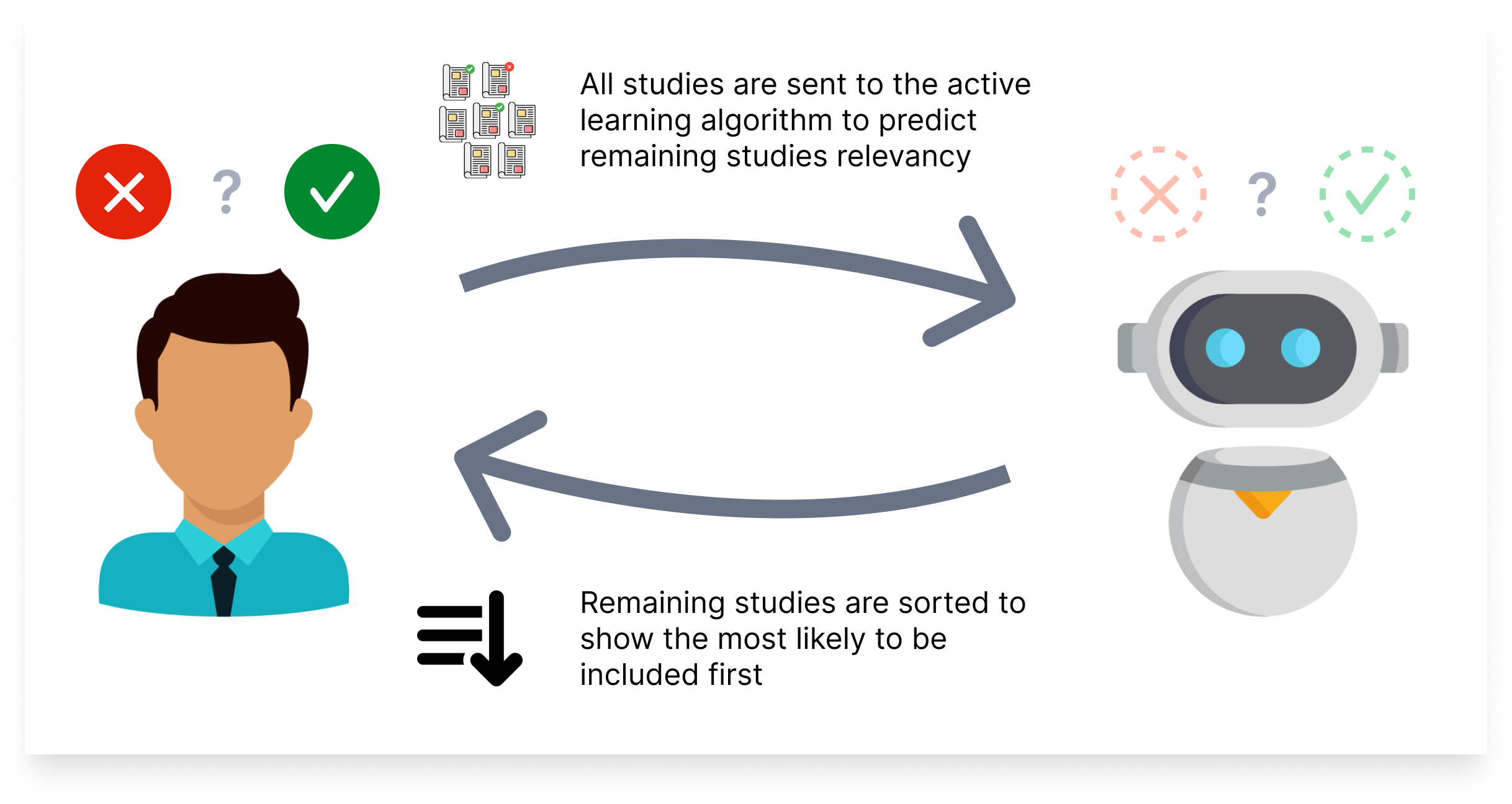
When sorting by “Most relevant”, Covidence will display the studies that are most likely to be included first. This helps teams move relevant studies through to the full-text review stage sooner.
The “Most relevant” sort uses an active learning machine learning model, developed by EPPI-Centre, to identify trends in your team’s past screening behaviour on the review to determine and display the studies that are most likely to be included first. The more studies you screen, the stronger the system’s prediction will be:
Evaluation
Miwa 2014 describes how the active learning algorithm works and the benefits of using it to support screening.
Known limitations
Given the machine learning uses patterns in your team’s past screening behaviour to determine the relevancy, it won’t begin to use the predicted relevancy scores to sort until at least 25 studies have been marked as included or excluded, with at least 2 of those studies being included, and 2 of those studies being excluded.
Due to technical limitations, the “Most relevant” sort feature will not work as expected for reviews with over 150,000 studies and reviews with less than 100 studies. For these reviews, studies will order based on the order they were imported into Covidence.
Enabling the feature
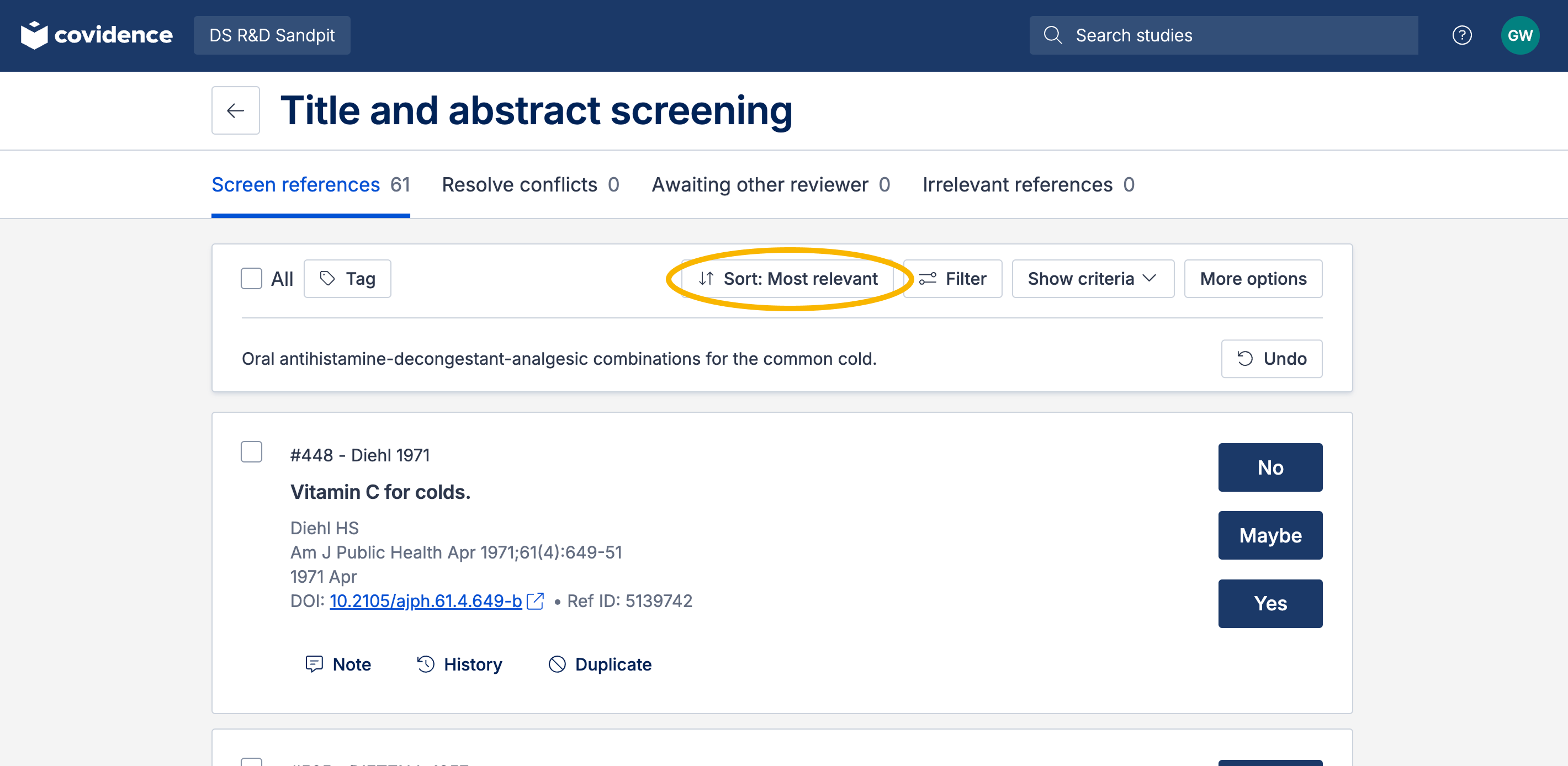
When title and abstract screening, sort by Most relevant.
Reporting feature usage
For your Manuscript (Methods Section) use the following text to transparently report use of this feature in line with RAISE standards:
We will use the “Most relevant sorting” feature (version not supplied, accessed on [dd/mm/yyyy]) developed by Covidence, to prioritise references during Title & Abstract screening by displaying studies most likely to be included first. This feature uses an Active Learning model developed by the EPPI-Centre and endorsed by Cochrane, which analyses patterns in the review team’s screening decisions to predict which studies are most likely to be relevant. Its predictions improve as more studies are screened.
The tool will be used according to the Covidence user guide with no customisation, training or parameter changes applied.
Outputs from the tool are justified for use in our synthesis because:
Human reviewers retain full control: All references, regardless of their sort ranking, will be screened by human reviewers, ensuring that study selection decisions remain fully human-determined.
Evidence-based prioritisation approach: Active Learning is a well-established method shown in multiple evaluations to accelerate screening workflows without compromising recall. Covidence’s implementation follows standard AL patterns (training on reviewer labels, updating predictions iteratively), which aligns with best practices in machine-learning-assisted screening.
Limitations of the tool include:
Potential domain bias: The model is trained solely on the reviewer’s own screening decisions within the current review project. If decisions are inconsistent or if the review spans highly heterogeneous subfields, relevance predictions may be less reliable.
Risk of automation bias: While all references are still assessed by human reviewers, reviewers may perceive early-ranked items as more important and this may influence their independent judgment in ways the tool cannot fully safeguard against.