


Welcome!
The University of Bath offers current staff, researchers, and students access to its institution-wide licence for Covidence.
Covidence is a web-based software platform that streamlines the production of systematic reviews. It supports reference/citation screening, full-text review, risk of bias assessment, extraction of study characteristics and outcomes and the export of data and references. In Covidence, you can work with:
Unlimited reference screening for each review
Unlimited number of collaborators for each review (irrespective of their affiliation)
How to access the University of Bath's licence account with Single Sign-On (SSO)
New Users:
If you have not yet signed up to Covidence with your University of Bath (UoBath) email address you need to create a new account. You can do this by simply signing in via Single-Sign-On (SSO).
Go to the Covidence Sign-up page, select Create account with SSO and enter your UoBath email address.
You will be redirected to your university's SSO login page, and enter your university credentials. If entered correctly, you will be redirected back to Covidence.
A prompt will appear if you have an existing account with a different email address and ask if you would like to connect it with UoBath's SSO and keep your work in one place. Sign in if you have the other account's credentials OR continue with 'Create a New Account'
Existing Users (Option 1):
If your existing account is registered with a non-university email address and not used your University of Bath email address on Covidence before, would like to keep your work all in one place/account:
Sign in to your account using the current email and password via the sign-in page
Go to Profile settings and add your UoBath email address
Verify the email through the confirmation message sent to the email address you added
Sign out of Covidence
Go to the Covidence SSO Sign-in page
Enter your UoBath email address
You will be redirected to your university's SSO login page, and enter your university credentials
If you have entered the correct credentials, and the university email matches the one added, your existing account will link automatically; if not, you may see the merge window prompt from 'New Users' above
Existing Users (Option 2):
If you have previously used Covidence and already have a user account associated with your UoBath email address, simply log in via SSO to see your existing reviews and to create new reviews.
Go to the Covidence Sign-in page, select Sign in with SSO, and enter your UoBath email address.
You will be redirected to your university's SSO login page, and enter your university credentials. If entered correctly, you will be redirected back to Covidence.
Whenever you sign in via SSO, whether to a new account or an existing account, your account will be linked to the university licence.
Please note: If you sign in to your account via a method other than SSO, you’ll see all your existing reviews and be able to work on them. However, you'll not be able to start new reviews under your university licence. If you have gone to the Start a New Review page and the University licence is missing, where you think it should be available, check first to ensure you have signed in to Covidence via your university SSO.
Starting a review under the University of Bath's licence account
Sign in to Covidence
Select Start a new review
Under 'Which account do you want to use?", make sure to select University of Bath
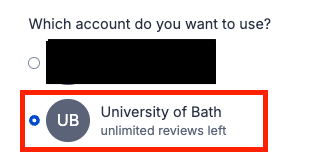
Please note: If you have started a review in the wrong licence, please contact support@covidence.org
Who can see my reviews?
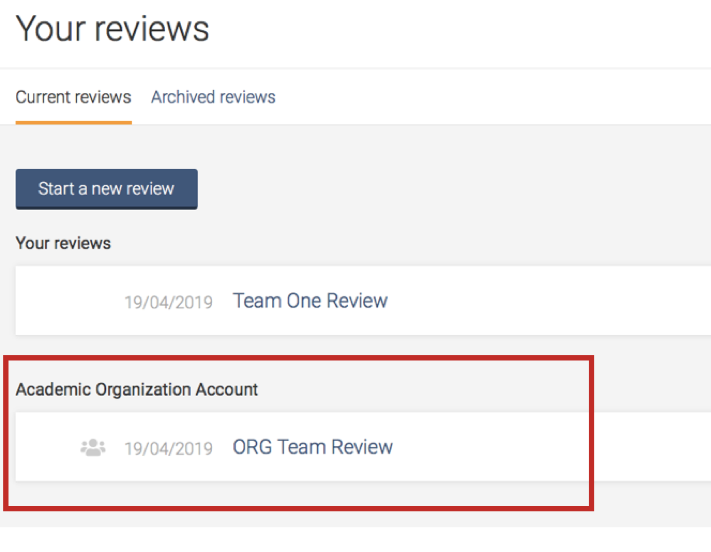
Reviews created using the licence account will be visible to Covidence subscription administrators at the university. Reviews created using your personal account are only visible to you.
Once you have created a review or accepted an invitation to another account review, the title will appear in a separate section on your account homepage:
Working with review team members and from other organisations/institutions?
Once a review is created with the licence account, you can invite unlimited internal and external reviewers to work with you on the review.
From the homepage (Your reviews), select the review you wish to add co-reviewers to and click on “Settings”

From the review Settings, navigate to “Reviewers”
Click on the “Invite another reviewer” button and enter the name and email address
More about Covidence
The Covidence interface is intuitive and suitable for students and experienced reviewers. Covidence can save time on repetitive review tasks, enabling faster review production and more time for analysis and interpretation.
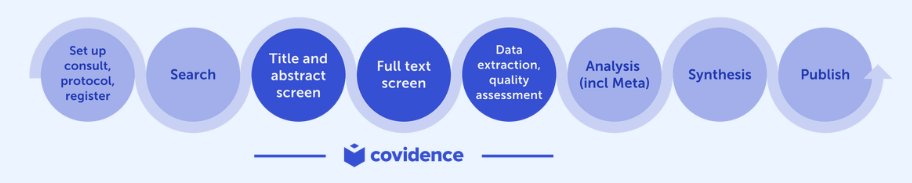
Discover more about Covidence on each link:
Import references - Covidence works seamlessly with reference management software such as EndNote (Desktop or Online), or any tool that supports RIS or other file formats. Covidence can automatically remove duplicates for you.
Screen title & abstract - Breeze through screening with keyword highlighting & a lightning-quick interface. Covidence keeps full records of who voted and supports single or dual screeners.
Bulk PDF import - Transfer PDFs stored in your reference manager to Covidence in a few clicks.
Screen full text - Decide quickly on studies in full text. Capture reasons for exclusion and any notes so you can resolve any disagreements quickly, with a click of a button.
Create forms - Be in control and stay focused on your PICO question. Customisable extraction forms mean you only spend time extracting what you need.
Customise risk of bias - Automatically populate your risk of bias tables by highlighting and commenting on the text directly in your PDF.
Conduct data extraction - Extract data efficiently with a side-by-side view of your customised form and PDF. Then, when you are done, easily compare your form with other reviewers.
Export - Covidence exports to all the common formats, so you can continue your review in your preferred software.
Collaborate - You can invite other reviewers (including external colleagues) to work with you on the project.
Support from Covidence
Covidence offers a range of available resources and support to help you along the way with your systematic review process.
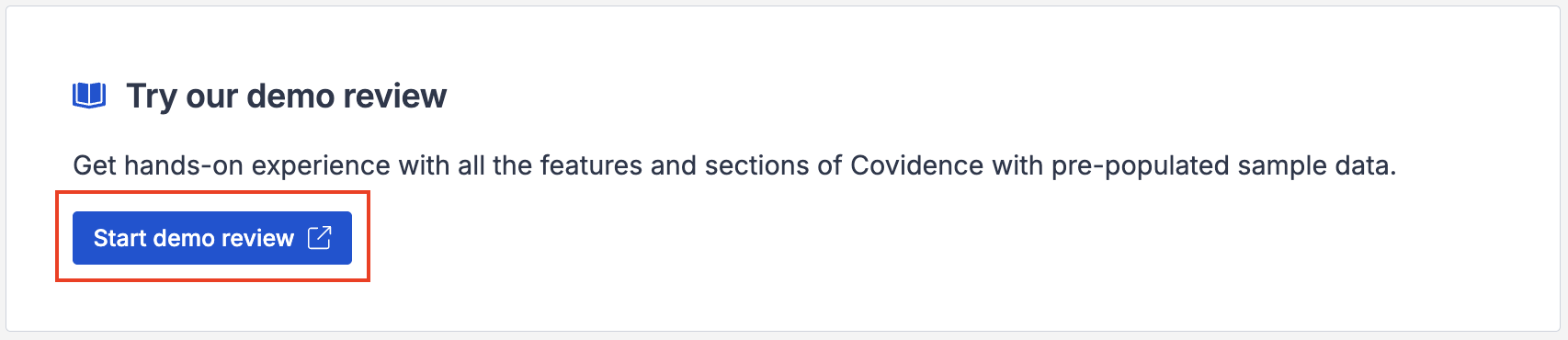
To get familiar with how a Covidence workflow works, you can try our pre-set Demo review. This will allow you to gain hands-on experience and better understand the process. You will find it at the bottom of your dashboard once you have signed in. Give it a go and feel free to explore!
Getting started with Covidence - video tutorials that guide you through the initial area to get you started.
Covidence Knowledge Base - home to all of our comprehensive articles, instructions and advice to FAQs.
Covidence Academy - Learn and understand the essentials of systematic reviews and gain insight with expert-led training and content to guide you through every step of the review process.
Covidence eBook Collection - Download our step-by-step practical guides for Systematic Review Success!
Monthly Open Training Webinars - Join our Community Team for free webinars (registration required) or watch our recent recordings without delay.
Online Support Team- contact our team directly for support on your review by emailing support@covidence.org
When logged into your account, you can also easily contact the Support Team via the chat icon in the lower-right corner, and access comprehensive articles from our Knowledge Base via the '?' icon in the upper-right corner of the in-app window.
Maintaining Access to Your Work When Leaving the University
You are required to add a secondary email address before leaving, as this will ensure uninterrupted access to your Covidence account.
If you need to log back into your Covidence account but cannot because you don’t have access to your university email address anymore, please get in touch by emailing support@covidence.org.